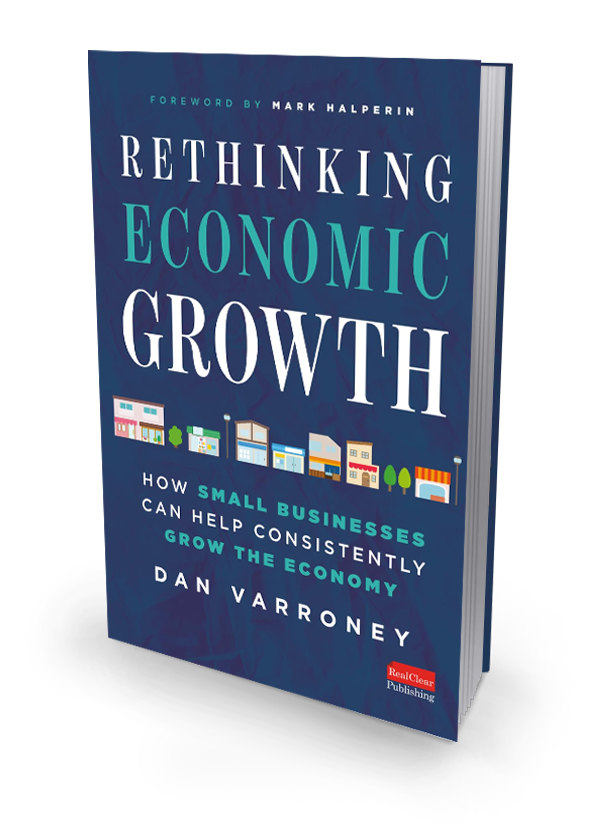
 For decades, America’s economic growth has been erratic, surging in some years, stagnating in others. Despite being the largest and most productive economy on Earth, we’ve consistently failed to sustain the 3% annual growth rate economists agree is essential to maintain prosperity, global leadership, and rising living standards. The United States can and must do better.
The solution is hiding in plain sight: America’s 33 million small businesses. They employ nearly half the workforce, generate two-thirds of new private-sector jobs, and contribute almost 44% of U.S. GDP. They are the heartbeat of our communities, the backbone of our economy, and the engine of innovation and resilience. Yet policymakers continue to overlook their potential or worse, undermine it through outdated policies and bureaucratic neglect.
It’s time to rethink economic growth not through the lens of Wall Street or Washington, but through the reality of Main Street America. If we want sustainable, consistent growth above 3%, we must unleash the full power of small businesses. That means tackling three fundamental barriers: workforce shortages, regulatory overreach, and outdated tax structures.
The Workforce Crisis: Rebuilding the Talent Pipeline
Across nearly every industry, small business owners are saying the same thing: they can’t find enough skilled workers. In manufacturing, construction, logistics, energy, and beyond, job openings go unfilled, not because businesses aren’t hiring but because the talent pipeline has dried up.
Two forces are driving this crisis. First, a cultural obsession with four-year college degrees has come at the expense of vocational training and technical education. High schools have gutted shop classes, and young people rarely encounter trades as viable career paths. Second, many small businesses simply can’t match the salaries and benefits offered by larger companies while training workers to competency. The result is a vicious cycle: positions remain unfilled, owners spend more time “working in” their businesses instead of “working on” them, and growth stagnates.
But small businesses are finding creative ways forward from training programs for non-violent offenders that reduce recidivism to partnerships with trade schools and apprenticeship programs. Still, real change will require national commitment. We need a cultural reset that values skilled trades, reintroduces robust vocational tracks, and addresses healthcare costs so small businesses can compete for talent.
The Regulatory Avalanche: When “Enough” Should Be Enough
If workforce shortages are the number-one obstacle for small businesses, excessive regulation is a close second. The Federal Register the government’s daily log of rules and proposed rules now exceeds 96,000 pages. Many of these regulations, written for the excesses of massive corporations, land hardest on small firms that lack compliance departments and legal teams.
Large companies can absorb a $100,000 compliance cost without blinking. For a $5 million small business, that same cost can be crippling. Worse, regulations are often overlapping, outdated, or contradictory, forcing owners to navigate a labyrinth of rules any one of which could threaten their survival.
No one disputes the need for reasonable safeguards, but small business owners increasingly feel like the pendulum has swung too far. The solution isn’t deregulation; it’s smart regulation cost-benefit analysis, eliminating outdated rules, involving small businesses in policymaking, and ensuring that the bang is worth the buck.
Tax Structures: Incentives That Reward Growth
The third major obstacle holding back small business growth is an outdated and often punitive tax system. Too often, the tax code rewards scale, allowing large corporations to exploit deductions and incentives that smaller firms cannot access. Meanwhile, small businesses — particularly pass-through entities — face complex filings and unexpected liabilities.
Taxes should encourage reinvestment in growth. That means expensing for business investments, research and experimentation deductions, pass-through deductions, and estate tax reform. It means making 100% capital expensing permanent, not just for equipment and facilities but also for workforce training. A stable, competitive international tax code is equally vital, ensuring that U.S. businesses are not disadvantaged in the global marketplace.
The Magnifier Effect: How Small Businesses Multiply Local Prosperity
One of the most powerful yet underappreciated aspects of small businesses is their magnifier effect — the way their success radiates through local economies. Small firms don’t just hire workers; they buy goods and services from each other, building networks of mutual support and trust. These relationships, built on reliability and partnership rather than volume discounts, strengthen communities and create resilience that giant corporations can’t replicate.
A Road Map for Policymakers: Empower, Don’t Obstruct
If small businesses are the key to sustained economic growth, and they are, then supporting them it must be a national priority. That means more than speeches during National Small Business Week. It requires a strategic shift in policy across several fronts:
- Invest in workforce development.
2. Streamline and modernize regulation.
3. Reform the tax code.
4. Reimagine the SBA.
5. Foster local partnerships.
These steps will unleash the full potential of America’s small businesses and ensure a thriving, innovative economy for generations to come.
The Stakes: America’s Economic Leadership and Shared Prosperity
Sustaining 3%+ annual growth isn’t just an economic goal, it’s a social imperative. Growth at that level is what keeps the American Dream within reach. It’s what funds innovation, infrastructure, and defense. It’s what ensures rising wages, upward mobility, and optimism for future generations.
Failing to achieve it has consequences. When growth stagnates, inequality deepens, opportunity dries up, and faith in the system erodes. Small businesses are the surest path forward. They embody the values that built this nation: hard work, ingenuity, perseverance, and faith in a better tomorrow.
It’s time for policymakers, business leaders, and citizens alike to rethink economic growth and act decisively to unleash the full potential of America’s small businesses. If we do, we can not only achieve consistent 3% growth, but we can also build a stronger, more resilient, and more prosperous nation for generations to come.
Click here to order your copy of Rethinking Economic Growth
About the Author:
Dan Varroney is a leading expert on the intersection of economic policy and small business strategy, and the author of Rethinking Economic Growth – How Small Businesses Can Help Consistently Grow The Economy. Drawing on decades of experience working with trade associations and small business leaders, he offers a bold vision for how Main Street can power America’s next great era of growth.